Sir Patrick Stewart, the legendary British actor whose commanding presence made him one of the most recognizable figures in science fiction while his classical training earned him acclaim on the world’s great stages, has died at the age of 86. Stewart died Wednesday, October 28, at his home in Los Angeles, with his wife, musician Sunny Ozell, caring for him. His family announced his death Thursday, bringing an outpouring of tributes for an actor whose remarkable career stretched across more than six decades.
Stewart’s family revealed that he had been living with Alzheimer’s disease and Lewy body dementia, describing his experience with the illnesses as a “brief and poignant journey.” He spent his final days surrounded by family and friends, with music, prayer, laughter and tears. While early reports have frequently described Alzheimer’s and Lewy body dementia as his cause of death, the family’s statement says that he died following his journey with the two diseases; a more specific medical cause of death has not been publicly detailed. It is a heartbreaking revelation, particularly for an actor remembered for the extraordinary clarity, intelligence and strength he projected throughout his life and career.
Long before Star Trek, Stewart was one of Britain’s accomplished classical actors. Born in Mirfield, Yorkshire, in 1940 and raised in a working-class family, he discovered Shakespeare as a boy and eventually joined the Royal Shakespeare Company, where he spent 14 years performing some of theater’s greatest roles. Then, at 47, he accepted a television role he had been warned might go nowhere: Captain Jean-Luc Picard in Star Trek: The Next Generation. Instead, the series became a cultural phenomenon. Stewart gave Picard a rare combination of authority, intellect, restraint and humanity, playing him for seven seasons before returning to the character in feature films and, decades later, Star Trek: Picard.
A second generation came to know Stewart as Professor Charles Xavier in the X-Men films, beginning with 2000’s X-Men. Once again, he brought something more substantial to a genre role, making Xavier not simply a superhero character but a figure of wisdom, compassion and moral conviction. His career, however, was far larger than either franchise. He performed Shakespeare, Beckett and Pinter; earned a Tony nomination for his acclaimed Macbeth; won three Olivier Awards; and was knighted by Queen Elizabeth II in 2010 for his services to drama. Away from acting, Stewart also spoke openly about growing up in a home where his father violently abused his mother, later using his public platform to advocate for survivors of domestic violence.
There are actors who become famous for a role, and there are those rare performers who somehow make a role feel larger because they inhabited it. Patrick Stewart belonged firmly in the latter category. Whether standing on a Shakespearean stage, commanding the Enterprise or portraying Professor Xavier, he brought intelligence and dignity to his work without losing its humanity. Perhaps that is why the news of his death feels particularly poignant. Generations encountered Stewart in completely different worlds, yet they recognized the same unmistakable presence: that extraordinary voice, that quiet authority and an underlying compassion that made even the most fantastic characters feel deeply human. Sir Patrick Stewart leaves behind an extraordinary body of work—and characters that will continue traveling far beyond his lifetime.
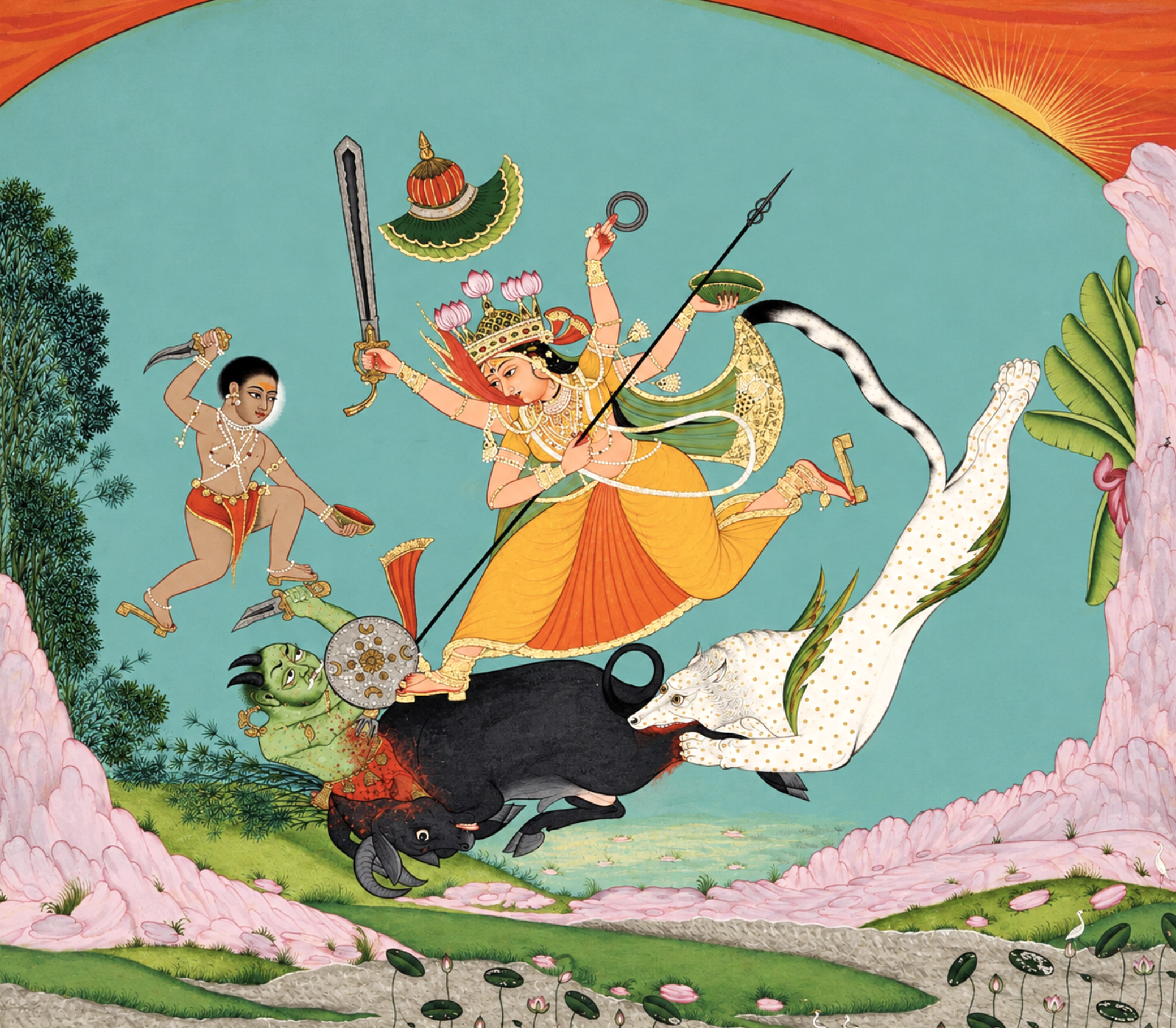
Shri Durga is one of the most beloved deities in the Hindu tradition. She represents the supreme Shakti, the Mother Goddess of all creation. In her form as the warrior Durga, she is a fierce power that removes all negativity and everything that keeps us from experiencing our true divine nature.
Shri Durga is invoked in times of great need, and she is known for her compassion and for protecting humanity. The Sanskrit word Durga literally means “inaccessible” or “a place difficult to overcome.” So Shri Durga is the one who carries us through difficulties and she who removes all difficulties and dangers.
In the Durgā Sūkta, we find the verse:
sa naḥ parṣad ati durgāṇi viśvā “May the divine power carry us across all difficulties.”
She is much more than a protector, though. Shri Durga represents Maha Maya, the power of the Universe that brings forth the world into creation. She is also the power that sustains it and dissolves it.
The Nārāyaṇī Stuti says:
सृष्टिस्थितिविनाशानां शक्तिभूते सनातनि
Sṛṣṭi-sthiti-vināśānāṃ śakti-bhūte sanātani
“O eternal one, you are the power behind creation, preservation and dissolution.”
And that same dynamic is always at play within us. In her role as a fierce goddess, Shri Durga is also what animates the body, what powers everything that is alive. And ultimately, she is the fierce power of grace. She is Kundalini Shakti herself, the divine power within all humans that purifies the mind and body, and the power that burns through the delusion that we are separate. The supreme Shakti of Durga is a powerful reminder that everything is connected.
In the tradition of yogic Tantra, Bija mantras, or seed mantras, are considered the most potent sound-form vibrations of the various deities, which represent various aspects of the Divine.
The Bija Mantra of Shri Durga is:
Om Duṃ Durgāyai Namaḥ
The meaning is:
Duṃ: The Bija Mantra of Durga, associated with protective, obstacle-destroying Shakti.
Durgāyai: To Durga.
Namaḥ: I bow or honor.
Here is a recording of the Durga Bija Mantra we did. You can simply sing along or listen to it while meditating.